Pistachio
View Products
Frozen Drieds
View Products
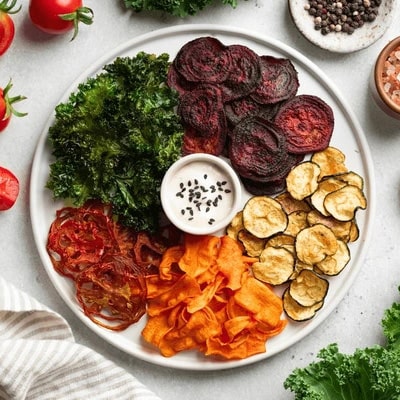
Dried Vegetables
View Products
Raisin
View Products
Dates
View Products
Dried Apricot
View Products
Figs
View Products

Saffron
View Products
Powders
View Products
Dried Fruits
View Products
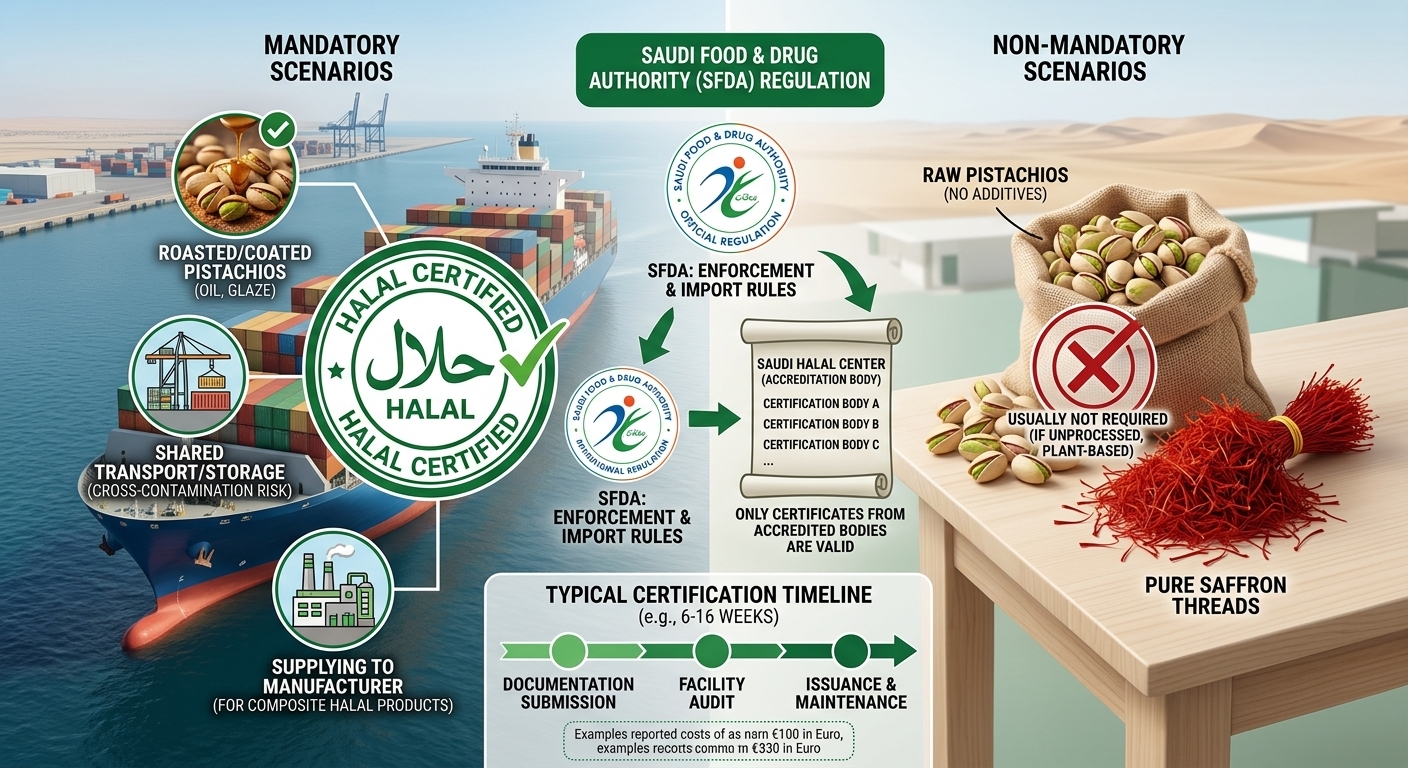
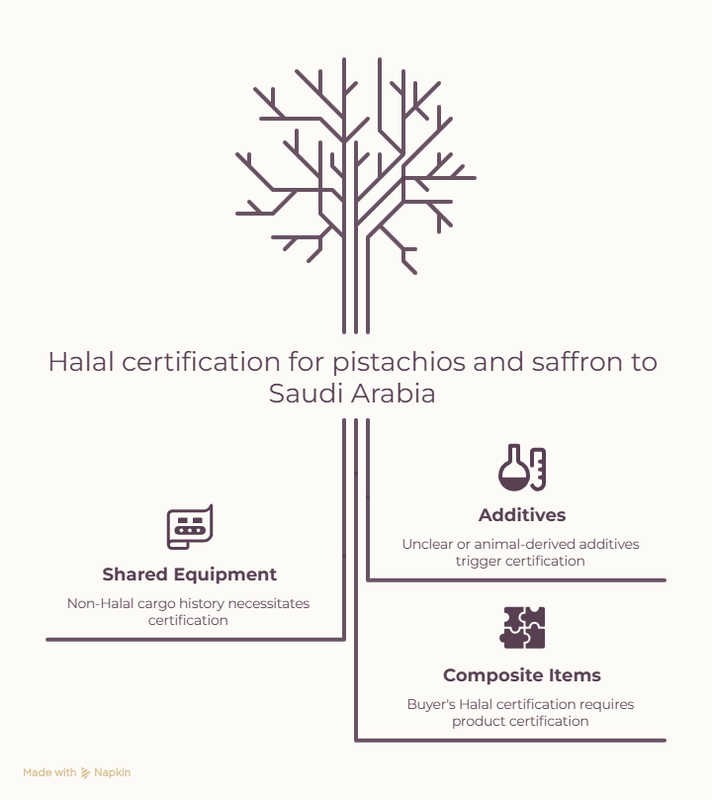
No, not always. Raw, unprocessed pistachios and saffron are generally not subject to mandatory Halal certification requirements, but the requirement becomes real in three situations:
Most exporters assume halal certification is a blanket requirement for anything entering Saudi Arabia. For pistachios and saffron, the real answer is more specific than that, and getting it wrong in either direction causes problems. Assume certification isn’t needed and a shipment can get held at customs. Assume it’s always mandatory and you spend money and months on a process the regulation doesn’t actually require for your product.
This guide breaks down exactly when halal certification applies to pistachio and saffron exports, who regulates it, how to verify a certification body is legitimate, what it actually costs and takes, and why many exporters get certified anyway even when the law doesn’t strictly demand it.
The short answer is that pistachios and saffron, as unprocessed plant products, are not automatically subject to Saudi Arabia’s mandatory halal certification rules. Those rules primarily target meat, poultry, and food products containing animal-derived ingredients such as gelatin, animal fat, rennet, or lipase.
That said, mandatory and irrelevant are not the same thing. Halal concerns can still enter the picture through processing aids, anti-caking agents, flavoring carriers, or shared transport and storage that previously handled non-halal cargo.
| Scenario | Halal Certification Needed? | Why |
|---|---|---|
| Raw pistachios or saffron, no additives, dedicated container | Usually no | No animal-derived content, no cross-contamination risk |
| Roasted or coated pistachios with oil or glaze | Likely yes | Coating origin may be animal-derived |
| Shared bulk storage or transport with non-halal cargo history | Yes | Cross-contamination risk in the supply chain |
| Sold to a manufacturer certifying a composite halal product | Usually yes | The buyer’s own certification depends on your documentation |
Saudi Arabia operates one of the strictest halal food frameworks in the world. As a baseline rule, non-halal food cannot be commercially sold in the Kingdom, and this applies broadly across meat, restaurant food, and packaged goods on retail shelves.
For raw agricultural commodities like pistachios and saffron, the practical exposure to this framework is narrower than it is for composite or animal-derived products, but it isn’t zero. Understanding where your specific product sits within this broader system is the first step before deciding whether certification is worth pursuing.
Saudi Arabia’s halal framework runs through multiple bodies working together, and knowing which one does what saves a lot of confusion.
| Authority | Primary Role |
|---|---|
| SFDA (Saudi Food and Drug Authority) | Food safety regulation, product registration, import enforcement |
| SASO (Saudi Standards, Metrology and Quality Organization) | Sets technical halal standards, including GSO 2055-1 and GSO 2055-2 |
| Saudi Halal Center | Accredits Halal Certification Bodies (HCBs) authorized to issue valid certificates |
SFDA requires that halal certificates for products that do fall under mandatory certification come exclusively from a Halal Certification Body accredited by the Saudi Halal Center. A certificate from an unaccredited body, regardless of how legitimate it looks, will not satisfy Saudi customs requirements.
This distinction between SFDA’s food safety role and SASO’s halal standards role trips up a lot of first-time exporters. A product can pass general food safety registration with SFDA and still face a separate halal compliance question depending on its composition and how it will be marketed.
Before paying anyone for halal certification, verify they’re actually on the Saudi Halal Center’s list of recognized bodies. This step gets skipped more often than it should, and it’s the single easiest way to avoid a wasted certification process.
The Saudi Halal Center publishes and maintains this list directly, and importers are specifically directed to check it before accepting a certificate as valid. A certification body with a strong reputation elsewhere in the Gulf is not automatically recognized in Saudi Arabia unless it appears on this list or holds accreditation under the regional GSO 2055-2 framework that Gulf Cooperation Council countries reference.
If your current certification body isn’t listed, either request an updated accreditation timeline from them directly or start the process with a body that already holds recognized status.
Three scenarios tend to trigger a real halal certification requirement even for a plant-based product.
The first is processing aids. Roasted or flavored pistachios sometimes use release agents, coating oils, or glazes, and some of these carry animal-derived origins depending on the supplier. Plain raw or dry-roasted pistachios with no additives carry much lower risk here.
The second is shared bulk handling. Silos, tankers, and shipping containers used for multiple commodities over time create a chain-of-custody question. If your saffron or pistachio shipment moved through equipment that previously carried alcohol, pork-derived products, or other non-halal cargo without documented cleaning, a halal audit may flag it regardless of the product’s own composition.
The third is end use. If your pistachios or saffron are being sold to a manufacturer who will use them in a composite product marketed as halal, that manufacturer will likely require your raw ingredient to carry halal documentation to support their own certification further down the supply chain.
A halal shipment certificate is distinct from a halal certification of the product itself. It addresses the transport chain rather than the ingredient composition, confirming that the vessel, container, or storage facility used for the shipment did not carry non-halal cargo that could create cross-contamination concerns.
For raw agricultural commodities like pistachios and saffron, this is often the more relevant document compared to a full product-level halal certificate. Buyers in Saudi Arabia and across the Gulf increasingly ask for shipment-level documentation specifically because it addresses the actual risk point for unprocessed goods, which is handling and transport rather than formulation.
Products that complete formal halal certification through a recognized body are entitled to display the Saudi halal logo on packaging and documentation. For pistachios and saffron sold directly to consumers or used in retail-facing products, this logo carries real weight with buyers, since it signals verified compliance rather than a self-declared claim.
For raw commodities sold business to business, the logo matters less on the packaging itself and more as proof your certification is genuine and traceable back to an accredited body. A buyer’s compliance team will typically check the certificate against the Saudi Halal Center’s records rather than relying on the logo alone.
There is no single fixed price or guaranteed timeline published by the Saudi Halal Center, since both cost and speed depend on facility complexity, product scope, and how complete your documentation is from the start.
As a general market reference, industry sources report certification timelines ranging from roughly 6 to 8 weeks for simpler, single-product applications, up to 12 to 16 weeks for more complex facilities handling multiple SKUs or shared production lines. Cost estimates vary just as widely. Reported figures for combined Saudi and UAE certification for European manufacturers with multiple products and facility modifications have run from roughly 23,000 to 38,000 euros in the first year, with annual renewal maintenance closer to 6,000 to 9,000 euros. A raw commodity exporter certifying a single, unprocessed product without facility modifications should expect meaningfully lower costs than that upper range, but should still request a fixed quote directly from an accredited body rather than assuming a flat industry rate.
| Factor | Typical Range | Notes |
|---|---|---|
| Simple single-product certification | 6 to 8 weeks | Fewer SKUs, no shared production lines |
| Complex multi-product or shared-facility certification | 12 to 16 weeks | More common for composite food manufacturers |
| First-year cost (complex, multi-market cases) | Roughly €23,000 to €38,000 | Reported for European manufacturers targeting Saudi Arabia and UAE together |
| Annual renewal maintenance | Roughly €6,000 to €9,000 | Varies by certification body and scope |
Always request a written, fixed-price quote from your certification body before committing, since these figures are market benchmarks rather than published official rates.
If your product or supply chain falls into one of the scenarios above, here’s the practical path to certification.
Cross-check any potential certification body against the Saudi Halal Center’s published list before engaging their services. Skipping this step is the most common and most expensive mistake exporters make.
Provide full ingredient lists, processing aid specifications, and supply chain details, including any shared storage or transport used. Incomplete documentation is the leading cause of delayed certification.
Most certification bodies require an on-site or virtual audit covering production practices, storage conditions, and traceability systems, not just a review of paperwork.
Once approved, you’ll receive your certificate along with guidelines for using the Saudi halal logo on packaging and shipment documentation where applicable.
Halal certification isn’t a one-time credential. Renewal cycles and periodic audits are standard, and any change to your supply chain or formulation should be reported to your certification body promptly.
Even where certification isn’t strictly mandated, plenty of exporters pursue it anyway. Saudi retailers and food manufacturers increasingly request halal documentation as a purchasing condition regardless of whether the law requires it for a given product category, since it removes ambiguity from their own compliance obligations further down the chain.
Certification also expands your buyer pool beyond Saudi Arabia itself, since many other Gulf Cooperation Council markets reference the same regional GSO 2055 framework. A single certification process can effectively open multiple markets rather than just one.
Not sure whether your pistachio or saffron shipment actually needs halal certification, or want help verifying a certification body before you pay for one? Our export team can walk through your specific product and supply chain with you.
[ 📩 Ask About Halal Compliance for Your Shipment ]
Is halal certification mandatory in Saudi Arabia for all food products? No. It’s mandatory specifically for meat, poultry, and food products containing animal-derived ingredients such as gelatin, animal fat, or enzymes. Plain plant-based products like raw pistachios and saffron generally fall outside this mandatory scope, though processing aids or shared transport can still create exceptions.
What is the Saudi Halal Center, and why does its list of recognized bodies matter? The Saudi Halal Center accredits the certification bodies authorized to issue valid halal certificates for the Saudi market. A certificate from a body not on this list will not be accepted by Saudi customs, regardless of how legitimate the certifying organization appears elsewhere.
Do I need a separate halal shipment certificate for raw pistachios or saffron? Often, yes, particularly if your shipment uses shared bulk containers, tankers, or storage. A halal shipment certificate addresses transport and handling risk, which is usually the more relevant concern for unprocessed commodities compared to a full product-level certification.
What does the Saudi halal logo actually verify? It confirms that a product completed formal certification through a body accredited by the Saudi Halal Center. For business-to-business raw commodity sales, buyers typically verify the underlying certificate directly rather than relying on the logo alone.
How much does halal certification typically cost? There’s no fixed published rate. Simple, single-product certifications tend to cost meaningfully less than complex, multi-product cases, which have been reported in the tens of thousands of euros for combined Saudi and UAE market access. Always get a written quote from an accredited body rather than assuming a flat rate.
Does halal certification for Saudi Arabia also work for other Gulf countries? Often, yes. Many Gulf Cooperation Council countries reference the same regional GSO 2055 standards framework, so a single certification can support access to multiple markets rather than just Saudi Arabia alone. Confirm mutual recognition with your certification body for your specific target markets.