Pistachio
View Products
Frozen Drieds
View Products

Dried Vegetables
View Products
Raisin
View Products
Dates
View Products
Dried Apricot
View Products
Figs
View Products

Saffron
View Products

Powders
View Products
Dried Fruits
View Products
View Products
View Products
View Products
View Products
View Products
View Products
View Products
View Products
View Products
View Products

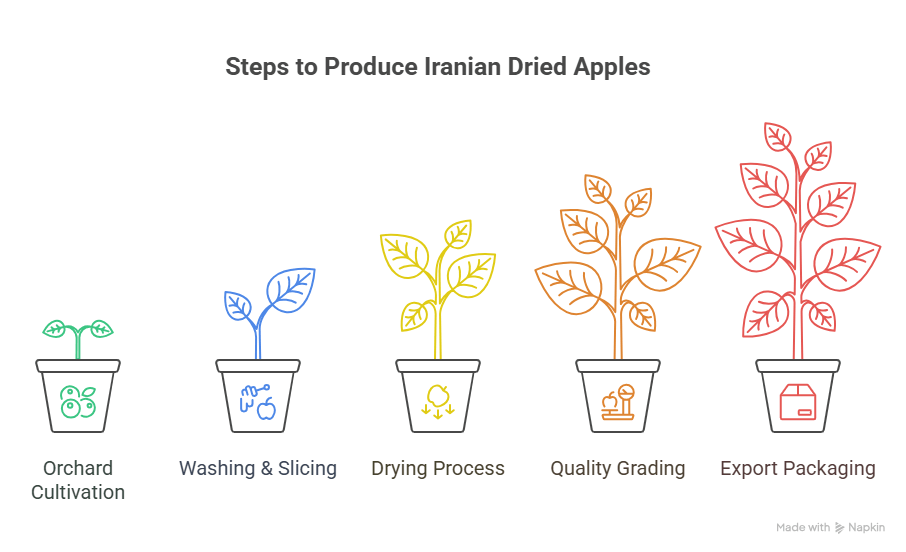
The journey of Iranian dried apples starts long before the fruit enters a processing facility. It begins in orchards where climate, soil and cultivation practices determine the quality of the final dried product, forming the foundation for premium Dried Fruits supplied to international markets.
Understanding this process provides buyers with clarity on consistency, safety and value. It also highlights why Iran remains a reliable source for bulk dried apple production in a market influenced by seasonal supply and the global price of dried fruits.
Iran’s Orchard Cultivation and Apple Harvesting Practices
Iranian apple orchards thrive in regions such as West Azerbaijan, East Azerbaijan and Semirom, where cold winters and mild summers support balanced sugar formation, making these areas ideal for producing high-quality Iranian dried apple.
Farmers focus on varieties suited for drying, including Golden Delicious, Red Delicious and Granny Smith. These cultivars maintain structure and color during dehydration, which directly affects export acceptance and the estimated price of dried apples in Iran.
Harvesting typically occurs when apples reach stable firmness and sugar levels. Ripeness indices are monitored through texture and soluble solids measurements, similar to the quality benchmarks applied in premium products such as Iranian dried cherry.
firmness and sugar levels. Ripeness indices are monitored through texture and soluble solids measurements. This early attention ensures that apples used for drying retain nutritional value and maintain a uniform finish after processing.
Once apples arrive at the processing facility, they are washed to remove dust and field residue. Sorting removes bruised or undersized fruit, a practice aligned with export-oriented strategies seen in opportunities in exporting Iranian dried cherry to Europe.
This step matters because a single defective apple can affect batch uniformity. Slicing machines create consistent thickness to ensure equal drying, helping producers meet international pricing expectations similar to dried cherry prices in global markets and in Iran.
Some producers peel the fruit depending on client preference, while others retain the peel for higher fiber content, a trend increasingly common across premium dried products such as dried peach.
Drying Methods Used in Iranian Apple Production
Drying determines flavor, color and shelf stability. Iranian producers use both traditional and industrial techniques, each offering distinct advantages.
This method relies on direct sunlight exposure. It is cost-efficient but requires longer processing time and careful hygiene control.
Apple slices pass through controlled hot air tunnels. Temperature, airflow and humidity are monitored to maintain moisture levels between 12 and 15 percent. This method supports large-scale export demand due to consistency.
Although costlier, freeze drying preserves nutrients and color with exceptional precision. It is often preferred for premium markets that value nutrient retention.
Producers examine color uniformity, slice texture, moisture stability and microbiological safety. Export buyers commonly request standards such as HACCP or ISO certifications.
Moisture control is essential because improper levels lead to color changes or microbial growth. Texture, aroma and absence of additives also determine grade categories.
Packaging ensures that dried apples remain stable during transport. Iranian factories use vacuum pouches or multilayer moisture-barrier films. Modified atmosphere systems protect against oxidation.
Labels contain information on origin, variety, processing date and shelf life. Cartons are reinforced to support long-distance shipment, particularly to markets in the Middle East, Europe and Asia.

They go through harvesting, sorting, slicing, drying and packaging in controlled facilities to maintain consistent moisture and quality.
Golden Delicious and Red Delicious are widely used due to stable texture and balanced sweetness.
Most export buyers request 12 to 15 percent moisture for stability during transport.